

Think in three rally states: attacking, defending, and fighting for the next attack. When your pair can keep hitting down, you normally organise front-and-back. When the opponents can hit down at you, cover the width side-by-side. Between those states, stay adaptable until one pair earns the advantage.
That sounds almost too simple. Then a club rally starts: somebody drops, somebody drives, your partner takes two steps forward, you both hesitate, and a shuttle lands exactly where each of you thought the other person was going.
The problem is rarely that players do not know the textbook shapes. It is that they change shape after the rally has changed instead of with it.
The rule underneath the whole guide
Position for what the next hitter can do. If your pair has a good chance to hit down, build the attack. If theirs does, build the defence. If neither side does, do not force a formation that the rally has not earned yet.
In this guide
Attack, defence and the fight in between What the Laws actually require How front-and-back attack works Why side-by-side defence is not two fixed boxes How to split when you lose the attack How to turn defence back into attack What to do in fast, flat exchanges Positioning around serve and return Who takes the middle? What if your partner does something different? What is worth remembering on a social club night? Frequently asked questionsAttack, defence and the fight in between
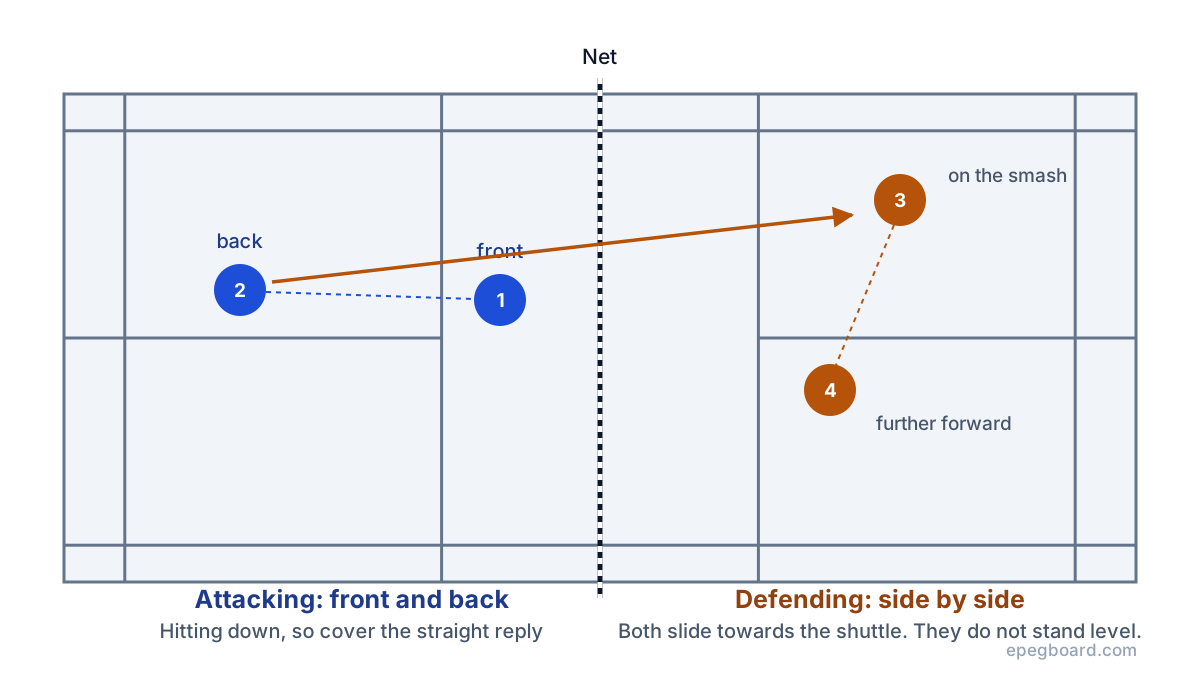
Most doubles coaching describes two basic formations: front-and-back for attack and side-by-side for defence. But it helps to add a third idea that is not another formation: the rally can be neutral, with both pairs fighting to get the attack.
| Rally state | Typical shape | Your priority |
|---|---|---|
| You are attacking | Front-and-back | Keep the shuttle going down and pressure the next reply |
| You are defending | Side-by-side | Cover the width, survive the pressure and look for a counter-attack |
| Neither pair owns the attack | Often roughly level or staggered | Take the shuttle early and create the first safe downward opportunity |
This is why the shortcut "up means defend, down means attack" is useful but incomplete. Your own lift normally concedes the attack because the opponents can get behind it and hit down. Their lift normally gives you the attack. And a weak downward shot can still surrender the advantage if the opponent reaches it above net height.
Ask a better question: who is likely to take the next shuttle from above net height or from a strong rearcourt position?
What the Laws actually require
Almost none of this is a rule of badminton. It is tactics.
During service, the server and receiver must be inside their diagonally opposite service courts and comply with the service requirements. Their partners may stand anywhere on their own side provided they do not unsight the opposing server or receiver.
Once the serve has been struck, the service boxes stop dictating where the four players stand. Either partner may hit the next shuttle from any legal position on their side. You do not have to alternate shots with your partner, and winning a rally does not create a positional obligation during the rally that follows.
This matters because club players sometimes protect "their side" as though a centre line ran through the whole rally. It does not. Your responsibility is whatever space the pair needs covered next.
How front-and-back attack works
The rear player creates pressure; the front player makes that pressure hard to escape.
From the rear court, the attacker normally wants downward shots - especially smashes, but also drops - that make a comfortable attacking reply difficult. The front player covers the forecourt and much of the midcourt, looking to intercept blocks, loose drives and pushes before the defenders can turn the rally around.
The front player should not be nailed to the centre line. If the rear player attacks from the right, the front player normally shades towards that side. Straight replies travel a shorter distance and tend to arrive sooner, so the pair's coverage follows the direction of the attack.
There is also an important non-rotation:
Smashing from the back does not, by itself, mean you should run to the net.
If your partner already owns the forecourt, charging forward beside them leaves nobody responsible for another lift. The attack works because the pair covers two different depths of court.
So when should the rear player come forward?
When the rally has already moved them into that role.
Imagine a short lift pulls the rear player forward. They reach it in the midcourt, play downwards and continue moving towards the net. Turning round and sprinting backwards simply because they started the rally as the rear player makes little sense. They have become the front player; their partner should recognise that and rotate behind.
A useful principle is:
Claim the space your movement has naturally taken you into; your partner covers the space that opens behind it.
That is more transferable than memorising a clockwise or anticlockwise dance.
Why side-by-side defence is not two fixed boxes
"Sides" is often taught as though each player owns one half of the court. Against a good attack, that is too static.
Side-by-side exists because a smash threatens the full doubles width. But both defenders still react to where the attacker is hitting from. If the shuttle is being struck from one rear corner, the pair normally shifts towards that side rather than leaving the centre gap unchanged.
The straight defender - the player on the same side as the attacker - faces the shortest, fastest line. They tend to be a little deeper and wider. The cross-court defender has more flight time and can often stand a little farther forward and closer to the middle, helping with drops and central replies.
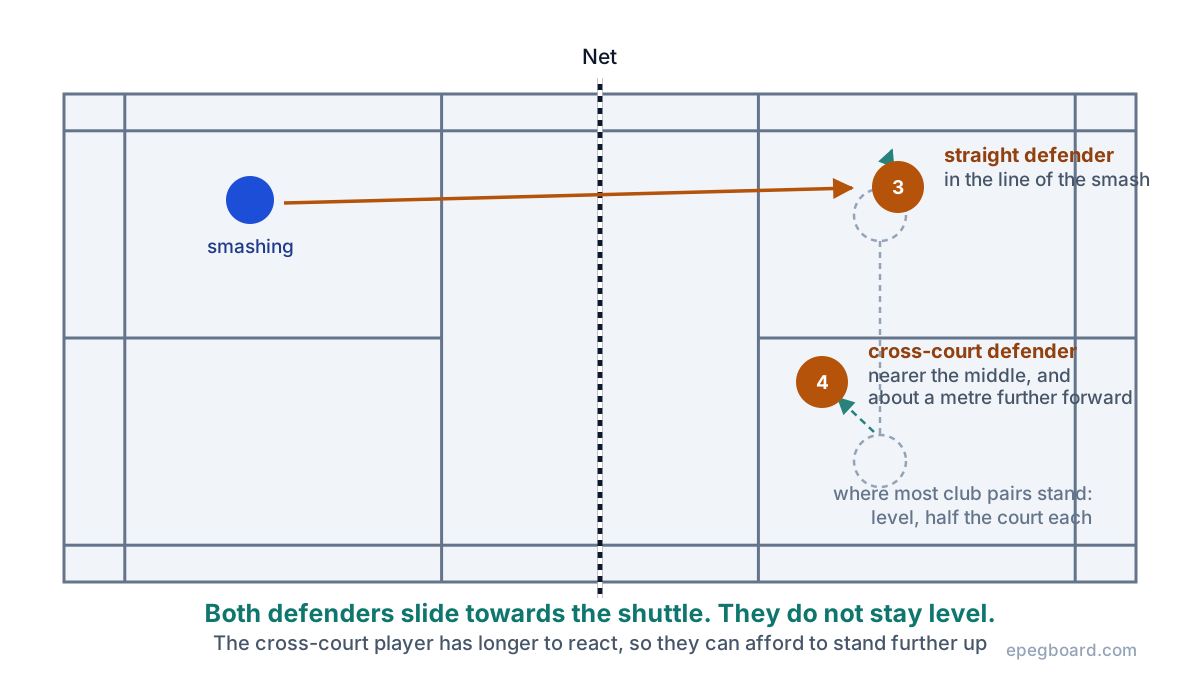
How much you shift depends on the quality of the attack. Against an opponent stretching desperately into a rear corner you can be more aggressive. Against somebody balanced under a short lift, give the smash the respect it deserves.
How to split when you lose the attack
This is where many club pairs collide.
You were front-and-back. One of you has been forced to lift. Both players now recognise "side-by-side", but there are two sides and half a second to choose them.
There is no universal law that says which player must go left or right. Established pairs develop patterns based on where they are, who hit the lift, handedness and the next likely attack. With an unfamiliar partner, sophistication is less valuable than predictability.
A practical fallback when you were clearly front-and-back is:
the front player commits to the nearest sensible side; the rear player, who can see that movement, fills the other.
This is a club convention rather than an official coaching law. Its virtue is information: the player behind can see the player in front, whereas the front player cannot safely turn around to negotiate.
If you were already roughly level when the lift was played, crossing the court is usually unnecessary. Recover towards the side you are already on unless the rally gives you a clear reason to switch.
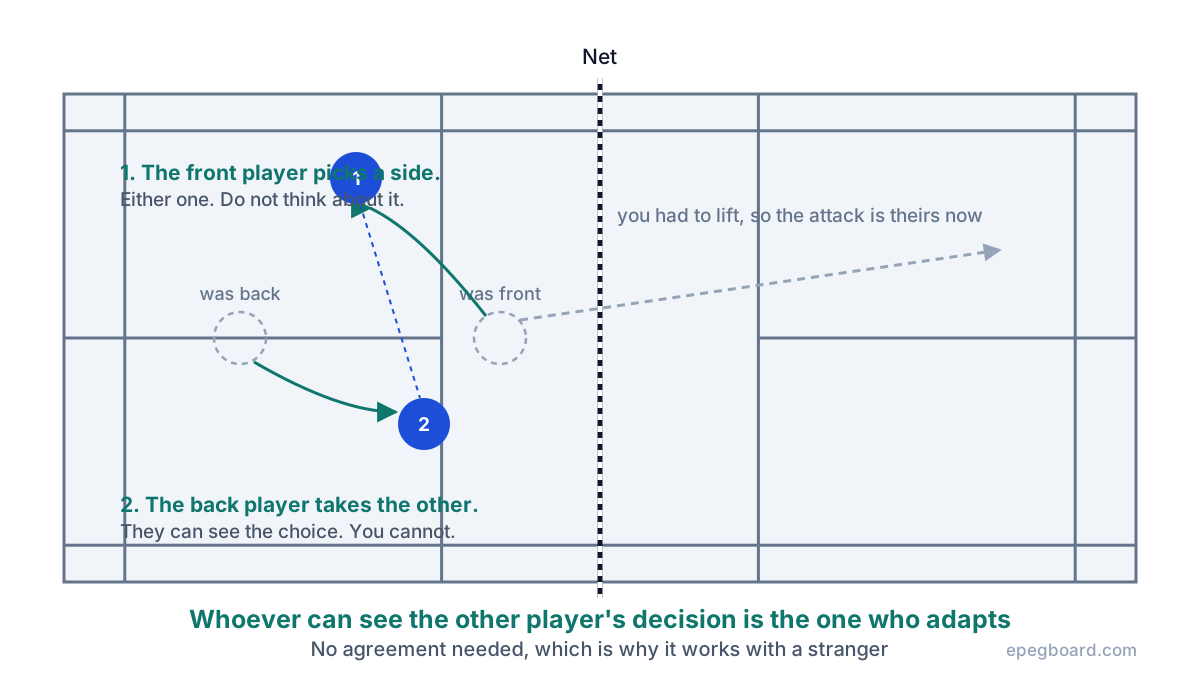
The objective is not to execute a perfect rotation diagram. It is to arrive in useful defensive coverage before the smash arrives.
How to turn defence back into attack
A lift may be the correct defensive shot, but it normally lets the opponents keep attacking. To change the rally, you need a reply that either gets past the front attacker or challenges them at the net.
Common options are:
- block to the net when you can control the smash well enough;
- drive past or at the front player when the smash is flat enough;
- push into the midcourt gap when there is space behind the front player.
A good block illustrates positioning perfectly. If you block the smash tightly and move forward behind your shot, you challenge for the net. Your partner can move behind you. If the opponents are forced to lift, your pair has changed from side-by-side defence to front-and-back attack without either player calling a formation.
But do not force the counter-attack. When the smash has you reaching late or off balance, a high lift can be the correct way to stay in the rally. "Never lift" is advice for losing points stylishly.
What to do in fast, flat exchanges
Not every rally belongs neatly to one pair. Drives through the midcourt often produce the most interesting state: both pairs are roughly level and each is trying to take the shuttle earlier than the other.
This is where charging the net after every strong-looking shot causes trouble. A drive can come back before you finish moving. Until somebody creates a clear advantage, stay compact enough to cover the next flat reply.
The transition often looks more like:
level → slightly staggered → front-and-back
than an instant switch.
Watch the height of contact. As your pair starts taking the shuttle higher and forcing the opponents to contact it lower, one player can press forward and the other naturally becomes the rear attacker.
Positioning around serve and return
A low serve is designed to deny the receiver an easy attack. After serving, the server is already near the forecourt and normally stays ready for the net or a flat return; the partner covers deeper replies. The serving pair is therefore prepared to form an attacking front-and-back shape.
The receiving pair is more conditional. The receiver normally stands far enough forward to attack a loose low serve. Their partner must read the return rather than stare at the receiver.
If the receiver attacks a flick serve or pushes the shuttle down from a good position, the partner needs to recognise that the pair may have gained the attack and move accordingly. If the receiver has to lift, the pair needs defensive width instead.
Serve positions are useful because they show the wider principle: your partner's shot is information about where you should move next.
Who takes the middle?
The shuttle between two defenders has a remarkable ability to make both players suddenly polite.
"Forehand takes the middle" is a common club rule. So is defending predominantly with a backhand grip and racket position, which makes a simple forehand rule less universal than it sounds. Opposite-handed pairs complicate it further.
There is no short rule that is optimal for every pair and every shuttle. What you need is shared expectation.
For a regular partnership, work out whose comfortable defensive range naturally covers the overlap, and adjust for handedness. With a new club partner, a ten-second agreement - "I'll take the middle if we're both there" - can be more useful than arguing about the theoretically perfect convention.
In attack the division is clearer. The front player should intercept shuttles they can take comfortably in front of them; the rear player covers what passes beyond that intercepting zone. A front player turning and running backwards after a shuttle that the rear player can take is usually creating two problems from one.
What if your partner does something different?
Club badminton is not a synchronised demonstration. Your partner may stay at the front after you expected them to rotate, defend much farther back than you do, or simply never have learned the same positional convention.
The worst response is to execute your preferred system harder.
Position relative to the partner you have, not the partner the diagram promised. If they occupy the front, cover the back. If they defend very wide, protect the central gap. If they do not rotate after a lift, avoid crossing through them merely to make the formation look correct.
Then talk between rallies. One useful sentence is better than a running commentary during every shot. Agree who has the middle or what happens after a lift and play again.
Calling "mine", "yours" or "leave" to your own partner is normal communication. The Laws prohibit deliberate distraction of an opponent; they do not require doubles partners to play in silence.
What is worth remembering on a social club night?
You can make this subject as complicated as international doubles. Most social players do not need to.
If you remember only three things, make them these:
- Your pair hitting down: think front-and-back.
- Their pair hitting down: think side-by-side.
- The rally changes: move into the empty space rather than insisting on the role you had two shots ago.
That alone fixes a surprising amount of club doubles. It also makes unfamiliar partnerships easier because both players are responding to the rally rather than trying to remember a bespoke rotation system.
If you only do one thing
Stop asking where you are supposed to stand. Ask who is likely to hit down next, then cover the court for that situation.
Positioning works better in games that are worth playing
ePegboard builds balanced, varied club-night games and rotates partners across the session. It cannot move your feet for you, but it can give you the kind of even games where positioning and partnership start to matter. Free for clubs.
Frequently asked questions
Should doubles partners play front-and-back or side-by-side?
Both. Front-and-back is the normal attacking shape because one player can pressure from the rear while the other intercepts weak replies. Side-by-side is the normal defensive shape because two players need to cover the width against a smash. In flat exchanges you may be roughly level while both pairs fight for the next attack.
Does a lift mean we should go side-by-side?
Your lift usually does, because it gives the opponents time to get behind the shuttle and attack downwards. Their lift does the opposite: it normally gives your pair the attack. Read what the next hitter can do rather than reacting to the fact that the shuttle travelled upwards.
Who takes the middle in doubles defence?
There is no single rule that solves every pair, especially when handedness differs. The important thing at club level is to have an understood convention and to communicate. A simple agreement beats two players each assuming the other owns the middle.
Should I follow my smash to the net?
Usually not if you smashed from the rearcourt and your partner already owns the front. You normally stay responsible for the rear attack. Move forward when the rally or your own movement has put you into the front role, not merely because you hit a strong shot.
Does this apply to mixed doubles?
The same ideas of attack, defence and transition still matter, but mixed doubles uses additional positional conventions and role preferences. This guide is a level-doubles baseline rather than a complete mixed-doubles system.
Where to go next
If by rotation you meant whose turn it is to play rather than how a doubles pair moves on court, start with fair player rotation on a badminton club night. If the difficulty is that games are one-sided before the first serve, running a mixed-ability club night tackles the pairing problem instead.
Sources and scope
This is a club-level guide to level doubles, written around the established attacking, defending and neutral positional principles rather than a professional rotation system. Mixed doubles and established elite partnerships use additional conventions.
Sources: BWF Coach Education · Laws of Badminton · Badminton Bible: doubles positions · Badminton Bible: defensive shots.
Updated 26 August 2026.