

How to choose badminton club software for your club night
Before you compare products, work out which decisions your club actually needs the software to make. This is what matters when choosing badminton club software for a club night, in the order it matters - then see how 32 products score against exactly these criteria.
Start with ePegboard
It is free for clubs, it needs no player sign-ups, and it is built around the one moment that makes a club night hard: a court comes free and four people have to be chosen. You can see it working in about a minute without creating anything.
We make ePegboard. The comparison below names the products that beat it in specific circumstances, and the scored evidence behind it, including our own weaknesses, is published in full.
In this guide
One Tuesday night What it changes about your evening Whether clubs actually stay Where to see the products scored Live queue or planned rounds? Three things ePegboard does not do Other tools worth comparing Other limitations worth knowing Frequently asked questionsOne Tuesday night
Twenty-two people, four courts, and it is twenty past eight. Court 2 finishes. Someone who arrived at 8:05 still has not played. One of your regulars has just played three on the trot and wants to sit the next one out. Two players have partnered each other twice already.
On a peg board, you hold all of that in your head while four people wait and look at you.
ePegboard puts the next game on the screen the moment a court frees up, with the players it has chosen and how even it expects the game to be. You can take it, swap somebody out, lock a player in, or ignore it entirely and build the game yourself.
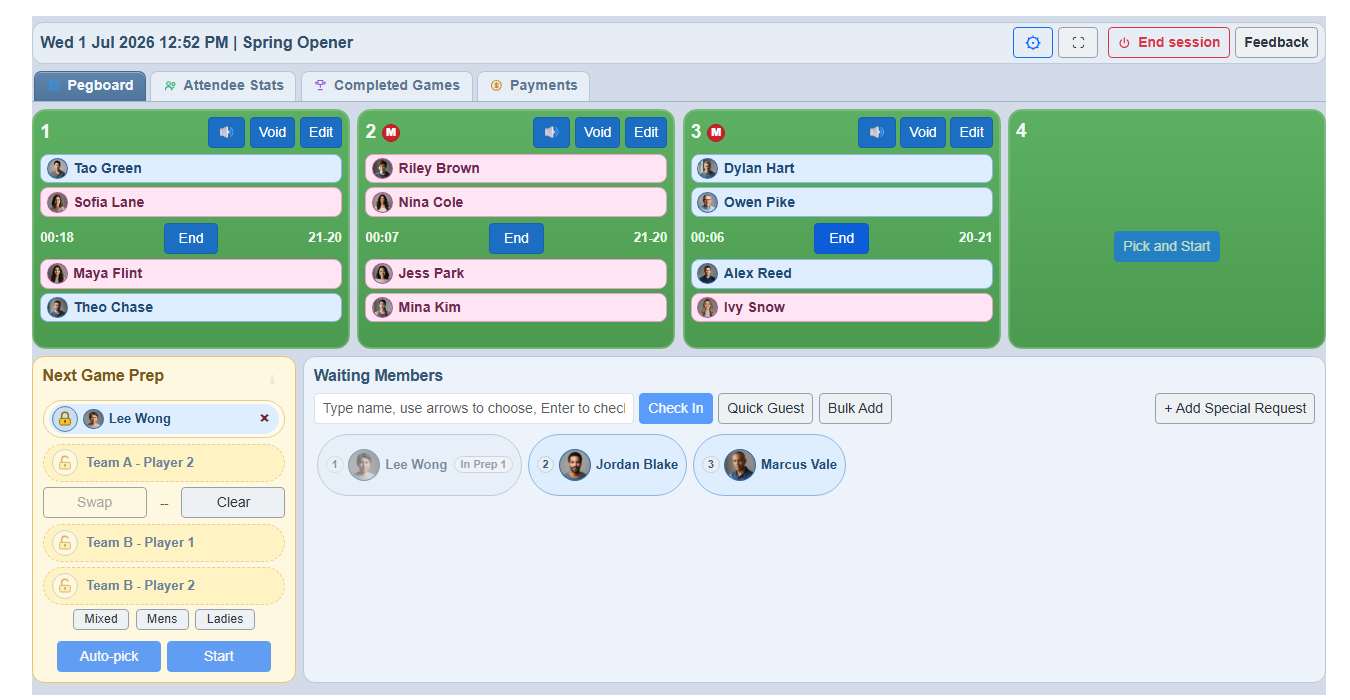
Courts in play, a free court ready to pick, who is waiting, and the controls to overrule any of it.
The late arrival comes into consideration because waiting time counts. The player who wants a rest is paused with one tap and comes back in when they say so. The pair who keep being drawn together are steered apart, because recent partners count against a pick. None of it needs you to remember it.
What it changes about your evening
- It aims for closer games. The picker balances the four players on their ratings and shows what it expects the score to be, so more of the evening is worth playing rather than a formality.
- Sitting out is shared out. Waiting time is part of the decision, so the same three people are less likely to carry the evening's rests.
- The selection can be explained. The pick is on a screen with its reasoning visible, so "why am I not on?" has an answer that is not just your judgement.
- You get more of your own evening back. That is the actual point. An organiser who is not running the board all night is an organiser who can be on court.
Practical things that matter on the night: no player accounts are needed, a shared tablet or laptop can run the whole session, late arrivals and early leavers are ordinary rather than disruptive, and you can always overrule the software.
Whether clubs actually stay
The honest test of any of this is not a feature list, it is whether clubs run a second night.
Four in five clubs that ran a first night with ePegboard since June came back for another, and of those, more than four in five have gone on to run five or more nights.
Separately, we commissioned AI evaluations of thirty club-night products against a rubric written before anything was scored. ePegboard came first in all three runs. We have published all of it - the prompts, the scores, the products we could not assess, our own weaknesses, and the places a rival beats us.
Where to see the products scored
Once you know which of the decisions above matter at your club, the next question is which products do them well. We scored 32 badminton club-night products against a published 100-point rubric built on exactly these criteria, and ran the whole evaluation three times to test whether the result held.
See how the current products compare against these criteria
Best overall, best offline, best phone-first, best for payments and best for leagues - with every score, every limitation and a link to each product's own site.
Live queue or planned rounds?
Before comparing ratings or leaderboards, decide whether the software should plan the evening as it happens or as a sequence of rounds. It is the decision most comparisons skip and it rules out half the market either way.
A live system waits for a court to finish, looks at who is available now and chooses the next game. It absorbs late arrivals, early departures and courts finishing at different times. A round-based system generates the whole evening up front: legible, printable, and constantly edited by reality.
Neither is better. A stable nine-player group may prefer knowing all five games at 7pm. A twenty-plus club with arrivals until 8:15 almost certainly wants live decisions. ePegboard, ShuttlePilot, Court Manager, ShuttlSync, ShuttleStats, NextFour and QourtX are live; SportRevive plans rounds.
The second question is worth asking any vendor: what can outweigh queue order? Skill, partner repeats, a requested rest? Ask them to explain a case where the longest-waiting player is not picked. The answer tells you how the product actually behaves at 9pm.
Three things ePegboard does not do
These are not preferences. They are capabilities we do not have, and if one of them is your actual problem then another product is the better first call.
- Collecting money: ShuttleStats. If chasing session fees drains more of your week than choosing games does, this is the closer fit. Members book and pay through Stripe with capacity, waitlists and refunds attached, and there is no subscription - the club pays a flat fee per member payment. ePegboard records what was paid; it does not collect it.
- Running without a reliable internet connection: Court Manager or ShuttlSync. If your hall has no signal worth trusting and mobile data or a hotspot is not a dependable fallback, you need software that keeps running offline. Court Manager runs on the device and does exactly that, including handling venue login pages that interfere with it; ShuttlSync supports offline sessions. Our web app needs a connection. Our only fully offline option is a separate Windows product at GBP 60 a year, and we are no longer developing it - major bug fixes only. If you truly cannot rely on a connection, pick one of those two rather than us.
- A planned evening rather than live picking: SportRevive. If your numbers are stable and you would rather hand out the whole night's rounds at 7pm, that is a different model and we do not offer it. See the section above on which one your club actually wants.
If several of those are your problem at once - subs, membership records and court booking together - then what you are shopping for is badminton club management software rather than a tool for running the night, and the shortlist above is the wrong shortlist to be reading.
Other tools worth comparing
These solve the same problem we do, in their own way. We would put ePegboard beside any of them, and none of them is a reason on its own to look past it.
- ShuttlePilot - phone-first and free while in beta. It is the only product we found that equalises sit-outs across sessions rather than only within tonight, which is worth knowing if the same people always seem to miss out. No published price after beta, and no shared court display.
- ShuttlSync - browser-based, with a rating that moves with results, seasons and achievements. Free to two live courts, GBP 9.99 a month to four, which is a ceiling worth checking against your club's size.
- NextFour - keeps the pegboard metaphor closest to a physical board, on phones. Core nights are free; pegboard and skill-based picking sit behind paid tiers bought through the app stores.
- Court Manager - the most direct peg-board replacement in the set, with unusually well documented fairness rules. Ranks are typed in by hand and never move on their own.
- QourtX - built across racquet sports, with membership and venue operations around the session. Worth one extra check before a committee budgets: its badminton page and its main pricing page describe different commercial models, so ask for the applicable plan in writing.
Other limitations worth knowing
Beyond the three above, from the same evaluations we published:
- Competitions are handicap doubles. Singles and team formats are not built.
- We publish the picker's signals but not their weights, so you cannot tune the balance between a close game and a long wait yourself.
- We optimise for a tablet or laptop. It runs on a phone, but a bigger screen gives the better experience. ShuttlePilot is built specifically for running the night one-handed from a phone.
If you want to test it properly
Do not test with eight well-behaved imaginary players. Run a real night and make it awkward: a late arrival after several games, someone sitting out and rejoining, two courts finishing together, a pairing you want kept, a suggestion you overrule, and a wrong score that needs correcting.
Then ask the one question that matters: did this take decisions out of my head, or just move them onto a screen?
Also test leaving. Export whatever the product says belongs to your club. A system can be free to enter and expensive to leave if years of results cannot come with you.
Frequently asked questions
What is the best badminton club-night software?
For a typical UK club night - a mixed-strength group, a few courts, people arriving late and leaving early - start with ePegboard. It is free for clubs and it is built around the specific moment a court becomes free. If your real problem is collecting money rather than choosing games, ShuttleStats is the better first call; if you need to run without a reliable internet connection, Court Manager or ShuttlSync.
Is there free badminton club-night software?
Yes, and more than one option. ePegboard is free for clubs. SportRevive is free. ShuttlePilot is free while in beta. ShuttlSync is free up to two live courts and ShuttleStats charges a fee per member payment rather than a subscription. Check the current pricing page before rollout, because these change.
Do players have to create accounts?
Not with ePegboard. A club night runs entirely from a shared screen with no player sign-ups at all, which matters because compulsory onboarding is where a rollout usually stalls. Accounts only start to earn their place if you want players to see their own history and ratings between sessions, and that stays optional.
Should club-night software work offline?
Only if you cannot rely on a connection at the venue, counting mobile data or a hotspot as well as the hall's own Wi-Fi. Where you genuinely cannot, it matters a lot. Court Manager documents offline operation in unusual detail, including handling venue login pages that interfere with it, and ShuttlSync supports offline sessions. ePegboard's web app needs a connection; its Windows desktop version runs fully offline but is a separate paid product that is no longer being developed, so we would not recommend choosing us on that basis. Test the actual failure mode before committing, not just whether the word offline appears on a page.
How do I run a fair club night without software at all?
A peg board and a queue works, and for a small stable group it may be all you need. The problems that push clubs to software are the ones a board cannot see: who has sat out twice while someone else has played every game, who has partnered the same person four times, and whether tonight's games were close. If none of that is a live complaint at your club, you probably do not need this yet.
Get comfortable with it before your next club night
Try the instant demo - it runs a session in front of you in about a minute, with nothing to set up and no account needed. It is the quickest way to see how it picks.
When you like what it does, set up your club and run one real night on it. It is free, your players do not need accounts, and the peg board is still there if you want it back.
Research note
Competitor descriptions and prices were checked against their public websites in August and September 2026: ShuttlePilot, Court Manager, ShuttlSync, ShuttleStats, NextFour, QourtX and SportRevive. This is a market snapshot, not a permanent feature matrix. The scored evaluations behind several claims here, including their method and their errors, are at epegboard.com/compare.